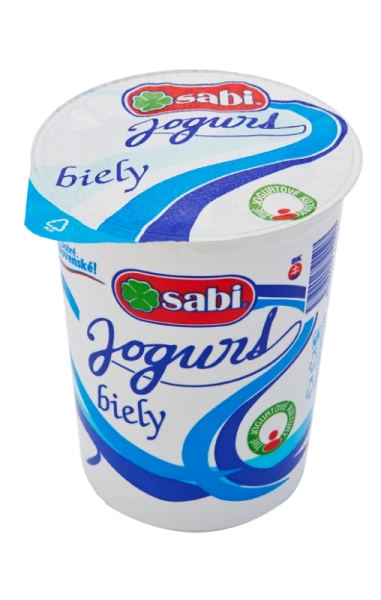
In Slovakia, Cottage Cheese, known throughout Western and Central Europe, has been produced for almost 20 years. We spoke about its production and advantages with Ing. Peter Kočiš, head of dairy production in Sabinov.
Your products bear the label: "Good Slovak!" Next to it, the name Cottage Cheese sounds a bit foreign...
This type of dairy product has no tradition in Slovakia. But customer surveys showed there would be interest in such a product. People got to know it during their foreign travels. Previously, this product type had no tradition in Slovakia, and no one knew what Cottage Cheese was. We evaluated this new market demand and decided to go for it in 2000.
There are several dairy producers in Slovakia, but only two produce Cottage Cheese so far...
It requires special technology. A dedicated production line. Nothing else can be produced on the Cottage Cheese line.
The line would not mind if the product had a Slovak name...
The name Cottage Cheese is established throughout Western Europe, and people know it by this name. If we Slovakized it, some would not know what it is. We wanted to keep the established product name. People already knew what was behind that name. So from the beginning, we have produced it under this name. For example, in Poland, the name is not translated either. And it sells "in quantities" there. Since customers are used to this name, they no longer question it. If we supplied the same product with a Slovakized name, some customers might be discouraged or think it is something else.
Of course, the name is not essential; what matters is what is behind it.
It is a fresh and easily digestible unripened cheese with a curdled consistency, with curds coated in cream. It is easily digestible and has high nutritional value. It contains easily digestible proteins, vitamins, and minerals, especially calcium. Since it is made from low-fat milk, it has relatively low fat content despite the addition of cream. But because the fat from the cream coats the curd particles, Cottage Cheese tastes like a full-fat product, is more delicious, and induces satiety faster.
So it is suitable for women who want a "wasp waist".
Yes, it is favored by those who monitor their calorie intake and athletes due to its high protein content.
How does it differ from "ordinary" curd? I read somewhere that it has "sweeter" curd because the acidification process is shorter...
The term sweeter could be misleading; in common language, sweeter means added sugar. No sugar is added to Cottage Cheese. Cottage Cheese also undergoes fermentation. The fundamental difference is the culture used in curd production versus Cottage Cheese production. Cottage Cheese uses exclusively homofermentative mesophilic cultures. Curd uses heterofermentative cultures. Homofermentative means only one type of mesophilic culture. Curd uses heterofermentative cultures, which include many types. Another difference is that curd cultures produce gas. After fermentation, curd rises, meaning it floats. In Cottage Cheese production, gases are not produced; the curd falls, settles at the bottom, and has a more homogeneous consistency without holes. Therefore, special mixers are needed to stir this curd.
So it is less acidic because the fermentation process is shorter and rennet is added...
Yes, that is true, but rennet is also used in fine curd that is not heated. So there is no difference there. Rennet is not added to double-heated curd; only cultures are used. In both cases, fermentation occurs, meaning lactose is converted to lactic acid, which causes coagulation. Of course, this works together with rennet.
Shorter and less acidic in numbers?
When the curd reaches pH 4.65 – 4.75, the cutting process begins. If cut earlier, the curd becomes very firm, almost rubbery. If over-acidified, the curd becomes very soft and crumbly. So the pH must be precisely timed for cutting. The fermentation time for Cottage Cheese is shorter; curd ferments longer, Cottage Cheese about 8–10 hours. So it is a shorter process. The added rennet accelerates the process.
As an expert, describe the process understandably for us, ordinary consumers.
The basis is quality low-fat milk and quality cream from Slovak milk producers only. We add the mentioned cultures and rennet to the milk. The milk is heated to a certain temperature (a technological secret, editor's note), at which fermentation occurs, breaking down lactose by the cultures and producing lactic acid, which acidifies the milk and coagulates milk protein. After reaching the specified acidity, the cutting process follows, using so-called harps, cutting into cubes about 1 x 1 cm. By stirring, the curd cubes become balls as they rub against each other, and the curd and whey mixture is heated up to 60 °C. This causes the grains to firm up. Then the whey is drained. Unlike curd, there is another specificity – the firmed grains are washed and cooled with drinking water at about 6 to 8 °C. Then the water is removed from the curd balls; this process takes about an hour. Meanwhile, cream is prepared and then mixed in a ratio of 2/3 curd and 1/3 cream. We add twelve-percent cream. Each producer can have their specifics. Cottage Cheese is made in various fat contents. There is 0.5% low-fat, classic 3–4.5%, and also creamy Cottage Cheese with added high-fat cream. Our specificity is that we use sour cream. Another is that we add probiotics (Bifidobacterium lactis) to enhance not only nutritional but also health benefits. The cream ferments for about twelve hours until the set acidity is reached, then cooled to stop fermentation. So we differ from competitors by having not only mesophilic cultures (dairy) but also probiotics in Cottage Cheese.
Original Cottage Cheese was made with sweet cream...
Cottage Cheese with sweet cream is still made. However, even when the mixture is cooled to a temperature where bacterial activity is significantly limited, fermentation, although very slow, continues. Thus, the taste and consistency at the beginning of the shelf life differ from those during and at the end. This is normal, but if you want consistent taste and texture throughout the shelf life, it is better to use a standardized process that can be controlled. You can never fully guarantee that the process stops after cooling. For example, psychrophilic bacteria produce enzymes even at 6°C, and if these enzymes survive pasteurization and get into the cream, they can cause a bitter taste, which is undesirable for this product.
The result is three types of Cottage Cheese...
The best-selling is white, then chive, and finally strawberry, which has the fastest growth in customer demand. Perhaps because high-quality jam (from a Slovak producer) with a high strawberry content and low added sugar is used for flavoring.
Thank you that Milk-Agro produces such an originally non-Slovak product, which has already been included among "Good Slovak!"